 QORPO
Unreal sound attenuation: listen along the route, not only at the source
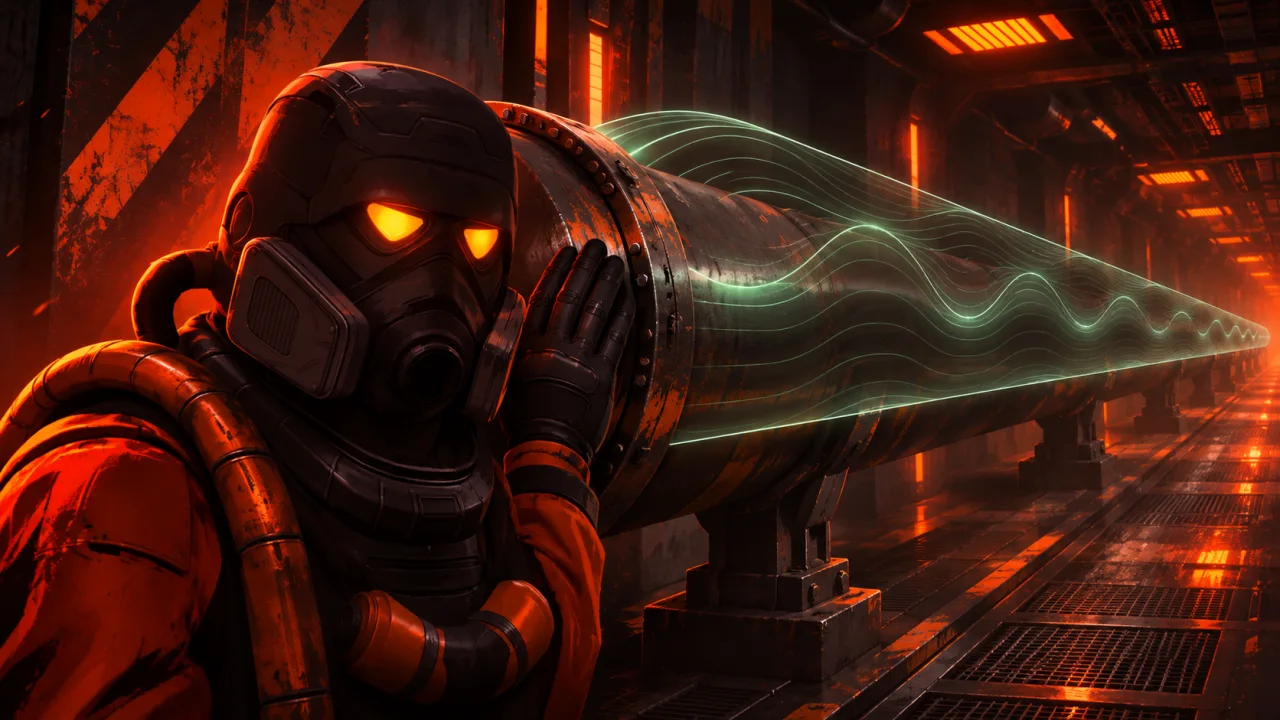
To review Unreal sound attenuation, listen along the route where the player needs the sound, not only beside its origin. Record the active shape, inner area and falloff, then compare an approach, a side position and a return with the same source and mix.
The aim is to decide whether the sound communicates the intended location and distance. This is a proposed review routine. It is not a measured audio improvement, a universal preset or a claim that QORPO has tested a particular level.
Name the sound's job
Choose one source and write a sentence about what the player should understand. A nearby machine might help locate a workshop. A room tone might establish a space without drawing attention to one exact point.
Then choose the part of the route where that information matters. Do not start by raising volume until the sound can be heard everywhere. That changes the problem before establishing what the listener needs.
Our sound effects mix review discusses judging a sound inside the game mix. This article focuses on the spatial route around one source.
Inspect the effective attenuation setup
Identify the settings actually applied to the source. Record the chosen shape, its inner dimensions, falloff and the relevant volume controls.
Epic's reference distinguishes the full-volume inner area from the outer falloff. It also documents shapes such as a sphere, capsule, box and cone. Those are different descriptions of how the attenuation area is arranged around the source.
An asset's name is insufficient evidence of its active settings. Inspect the source and any applicable override before comparing what you hear.
Match the shape to the intended area
Use an original model scene: a long exposed pipe makes a continuous mechanical sound. A listening position beside one end may be far from a source placed at its centre.
That is a reason to inspect the spatial design, not an automatic instruction to increase the radius. A route along the pipe and a route away from it ask different questions.
Epic gives an elongated pipe as a use case for a capsule. Treat that as a starting point for an experiment in your scene. The appropriate dimensions and mix still need evidence.
Keep the listener clear
The listener is not always identical to the visible character's location. Record the camera and listening setup used by the project, especially when comparing first-person and third-person presentation.
For the model fixture, stop at a chosen point, then turn through the directions relevant to play. Note whether the apparent source and useful cue remain understandable.
Do not label every difference in loudness a distance-attenuation problem. Directional processing, occlusion, the source material and the wider mix can also matter. Isolate the setting you intend to evaluate.
Walk three deliberate paths
First approach from outside the useful area toward the intended listening point. Next move beside the source or along its length. Finally return along the original route.
Keep source content, playback conditions and general audio settings consistent. Write down where the cue first becomes useful and where it becomes distracting or unclear.
These are qualitative observations unless you perform a defined measurement. Avoid turning “I could hear it” into an unsupported decibel figure or a claim about every device.
Compare in isolation and in context
An isolated source can reveal an abrupt transition that the full mix masks. The full scene can reveal a useful source being covered by other sounds.
Use both observations, while describing which condition produced each result. If several nearby sources compete, our concurrency guide covers a different part of the problem.
For a wall or doorway, the occlusion review is also relevant. A spatial shape does not by itself establish how an obstruction should sound.
Change one justified variable
If the model pipe disappears from hearing at an awkward point, record the position and intended result before changing the setup. Adjust one relevant part, then repeat the same paths.
That keeps a useful comparison possible. Changing source gain, shape, falloff and the master mix together can make the new scene sound different without explaining which change helped.
A practical evidence note includes build, device or output arrangement, route and settings. It also records remaining uncertainty, such as a comparison performed only with one pair of headphones.
Source and limits
Source: Epic's Sound Attenuation reference, checked on 27 November 2026. The model scene and listening routine are original examples.
No engine session, listening test or accessibility audit was performed for this article. Use the routine in a controlled project test, then follow QORPO Live for evidence tied to actual studio work.